
Fano is a city that tells its own story in every street, square and building. Strolling through the historic centre and the waterfront the link between past and present, between tradition and contemporary life is clearly perceived.
Numerous monuments e historic buildings allow you to discover a ancient history and glorious, made up of dominations, rebirths and transformations that have made Fano the fascinating city we know today.
Sangallo Bastion
An ancient testimony to the defensive system of the Malatesta walls, the Sangallo Bastion was designed in 1532 and completed in 1552. Today it is one of the city's main cultural spaces, hosting events, exhibitions and concerts.
Fountain of Fortune
Located in the central Piazza XX Settembre, the fountain probably dates back to 1552. It is surmounted by a copy of the statue of the Goddess Fortune, made in 1593 and now housed in the Malatesta Palace Museum.
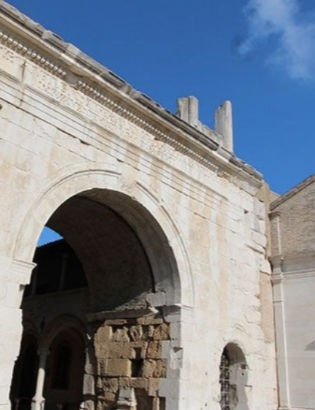
Augustus Arch
A monumental symbol of the city, it was built in 9 AD. Although it no longer has the original upper colonnade - destroyed by Federico da Montefeltro's troops - a bas-relief showing its original appearance is visible on the side façade.
Palazzo del Podestà - Fortuna Theatre
Built in 1299, it became home to the Teatro della Fortuna in the 17th century. Badly damaged during World War II, it was rebuilt in 1944 and is now one of the city's main cultural centres.
Malatesta Palace
A historic residence of the Malatesta family between 1357 and 1463, it now houses offices, the headquarters of the Cassa di Risparmio di Fano bank and the Museo Civico, divided into four sections dedicated to local history and art.
The Tower Houses
Five medieval tower houses can still be admired in the historic centre: fortified dwellings designed to quickly become defensive outposts.
Church of San Silvestro
One of the oldest in the city (12th century), it houses an altar embellished with a painting of the Madonna, resting on an ancient Roman capital.
Church of St Francis
An ancient, now deconsecrated church, it retains an evocative and timeless charm. The roof collapsed during the earthquakes of the 1930s, but the portico still houses the splendid Malatesta tombs.
Church of St. Augustine
Located on Via Vitruvio, it was badly damaged during the Second World War. The remains of a large Roman building are preserved in the basement.
Built around 1438, it had a large watchtower (Mastio), which was destroyed during the bombing of World War II. Today the fortress has been restored and hosts shows, events and cultural events.
Among the most fascinating archaeological discoveries of recent years, Fano holds a treasure that re-emerged in 2026 after more than five centuries: the Basilica attributed to Marcus Vitruvius Pollonius, a famous Roman architect from the 1st century BC.
The discovery, which took place during excavation work in the city centre, brought to light a building of extraordinary historical and architectural importance. Long known only through ancient sources, the basilica confirms the central role of ancient Fanum Fortunae in the Roman world. Today, strolling through the city, the past literally resurfaces beneath the footsteps of visitors.




All our offers and promotions in advance just for you. Leave us your email, we take care of everything.